














 From 150₾ Free Shipping
 Categories
 Sale
Sale
 profile
Affordable Office Stationery: How to Balance Price and Quality | Supta.ge


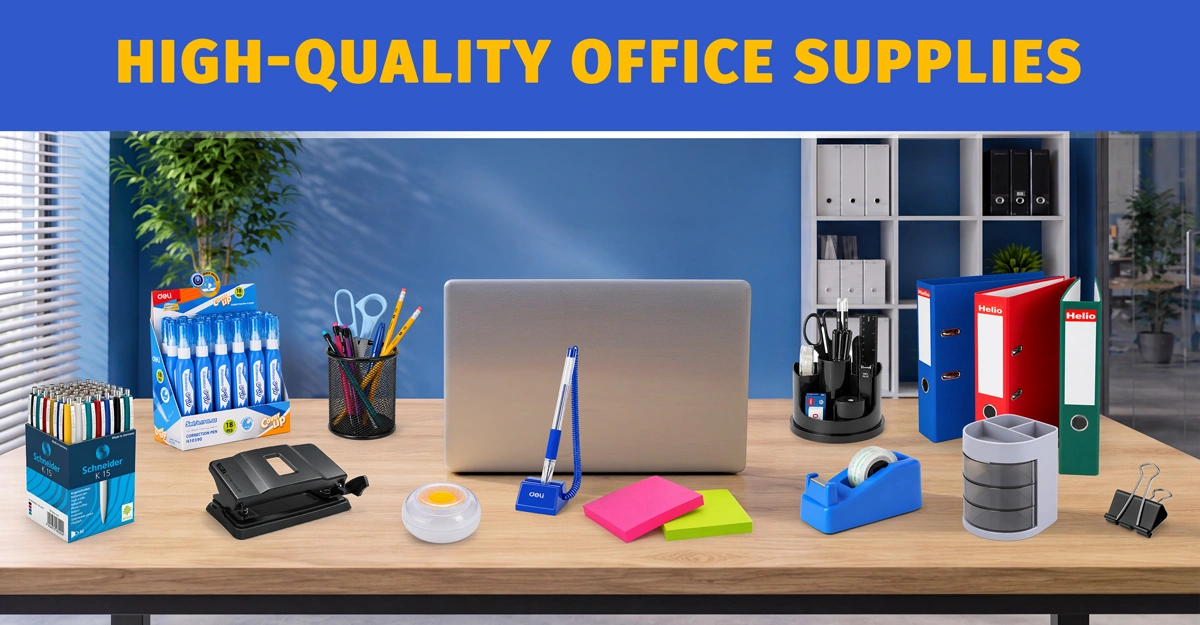
Can excessive cost-cutting on office supplies eventually cause workflow interruptions and additional expenses? Most businesses want to purchase affordable office stationery , but the product with the lowest initial price is not always the most economical option.
Poor-quality printing paper may jam frequently, pens may dry out earlier than expected, and an unsuitable stapler may slow down document handling. In these situations, the business loses both the money paid for the item and valuable employee time.
This article explains how to balance price and quality, select essential stationery and manage office stock more effectively. The aim is to turn procurement into a predictable system rather than a recurring operational problem.
What Does “Affordable Stationery” Mean for a Business?
For a business, “affordable” should not mean only the lowest number on an invoice. The real cost of a product also depends on how long it lasts, how often it must be replaced and whether it supports or interrupts daily operations.
For example, a pen that writes consistently, does not leak and lasts longer may cost more per unit but require less frequent replacement. The same principle applies to paper, folders, staplers and other office essentials.
Instead of looking only at unit price, consider durability, defect risk, compatibility with the task and the expected frequency of replenishment.
Rational Procurement Versus Simply Choosing the Lowest Price
The choice between economy and higher-grade products should be based on the intended use. A basic item may be sufficient for occasional use, while durability and convenience become more important for tools used every day.
For example, a folder kept in long-term storage has different requirements from a binder handled repeatedly by an employee. Suitable options can be compared in the binders, files and folders category .
Depending on document volume and frequency of use, businesses can choose binders , files or folders .
How a B2B Platform Supports Cost Control
Office expenses are affected not only by product prices but also by the time required to manage procurement. Communicating with multiple suppliers, processing separate invoices and tracking several deliveries increases administrative workload.
The Supta.ge business supply platform enables companies to combine stationery, paper products, cleaning supplies and other everyday goods within one procurement process. This simplifies planning and the organization of accounting documentation.
To review products selected for different workplace needs, visit the office supply solutions page .
Comparing Office Supplies — Where Is the Balance Between Price and Quality?
Price alone does not provide enough information for a useful comparison. Consider the material, construction, package quantity, frequency of use and suitability for the relevant task.
For writing instruments, review writing consistency, drying speed, comfort and expected lifespan. The pens and markers category includes options for everyday writing, presentations, labelling and other office tasks.
Businesses can compare pens for everyday notes, markers for boards and labelling, and pencils for sketches and erasable notes.

A4 Paper — Economy or Unnecessary Risk?
Printing paper is one of the most frequently consumed office resources. Standard office printing commonly uses 80 gsm A4 paper, but weight alone should not determine the choice.
Consider brightness, surface smoothness, opacity, suitability for double-sided printing and compatibility with the office printer. Paper that is too thin or inconsistent may jam more frequently, allow printed content to show through or produce more paper dust.
A4 and A3 options can be reviewed in the copy paper category .
Before ordering a large quantity, estimate actual monthly use. Excessive stock may occupy valuable storage space or become damaged by moisture, while insufficient stock can interrupt routine work.
Pens, Markers and Everyday Writing Instruments
Businesses can apply different selection criteria according to employee roles. Consistent and comfortable pens are important for everyday notes, while design and presentation may matter more for client-facing meetings.
For example, businesses can review a Schneider pen alongside other available models to compare writing quality, grip and price.
Markers should always be selected by purpose. A whiteboard marker must erase cleanly, while a permanent marker is designed to leave a lasting mark. Substituting one type for another may damage the surface or make information difficult to remove.
Staplers and Desk Accessories — When Is Better Quality Worth It?
A stapler is a small office item, but an unreliable model can quickly become disruptive when documents are processed throughout the day. An unsuitable stapler may jam, bend staples incorrectly or damage paper.
Before purchasing, check the sheet capacity, compatible staple size and refill method. Suitable products can be reviewed in the staplers category .
Businesses that regularly fasten larger document packs may require a higher-capacity option, such as a standing stapler for up to 150 sheets . Staple size must always match the specific model and document thickness.
Staplers can be combined with office desk accessories , including organizers, document trays and other tools used to maintain an orderly workstation.
Stationery Sets — Ready-Made Kit or Individual Selection?
A ready-made stationery kit can be practical when setting up a new employee workstation, opening a new office or equipping several similar desks.
However, a set is economical only when most of its contents will actually be used. Otherwise, creating an internal standard list and selecting products individually may be the better approach.
A basic workstation set may include pens, pencils, an eraser, ruler, stapler, staples, note paper, files and folders. Additional products should be selected according to the employee's responsibilities.
For notes, envelopes and other paper products, explore the stationery paper category , including notebooks and envelopes .
Hidden Costs — Why Can an Extremely Cheap Product Become Expensive?
A very low initial price may sometimes reflect a short useful life, frequent defects or limited suitability for the intended task. The business may then need to replace the product earlier than planned.
Hidden costs may include lost employee time, damaged documents, the administration of replacement orders, additional delivery expenses and unused stock.
For example, a stapler used with incompatible staples may jam repeatedly, while a leaking pen may damage important documents. The solution is not always to purchase the most expensive item, but to select the product that fits the actual requirement.
How to Reduce the Risk of Purchasing Poor-Quality Products
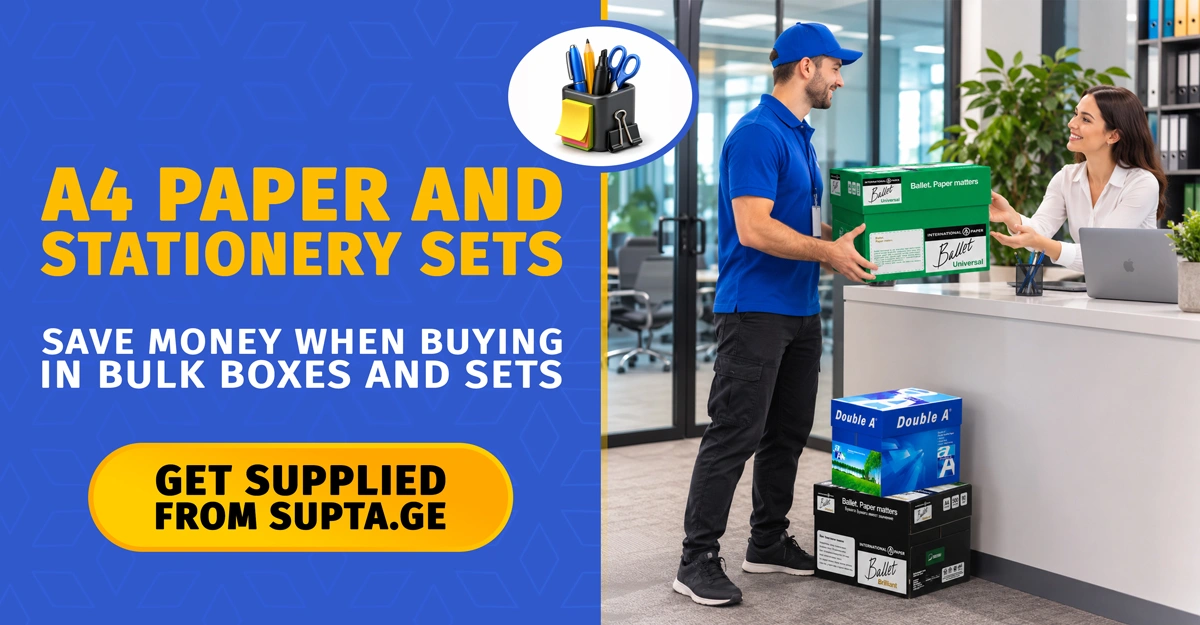
Efficient Inventory Management
Office work should not be interrupted because paper, pens or files unexpectedly run out. Define a minimum stock level for the products used most frequently.
Stock audits can be completed weekly or monthly, depending on company size and consumption. Record:
Create a standard office supply list and update it according to actual consumption data. This reduces both unexpected stockouts and unnecessary accumulation.
Advantages of Online Procurement
Online procurement allows businesses to compare prices, package quantities, specifications and alternatives without visiting several physical stores.
Purchase history also helps identify how often a product is ordered and whether current stock levels reflect real consumption.
In addition to stationery, businesses can combine office food and beverages , paper products and napkins , and cleaning and washing products within one order.
How Supta.ge Simplifies Office Procurement
Supta.ge enables businesses to purchase office stationery , copy paper, writing instruments, folders, desk accessories and other everyday supplies in one place.
Use the complete product catalogue to browse all available categories. For more practical guidance on office operations and business supply, visit the Supta.ge blog .
Businesses requiring recurring or high-volume orders can review partnership opportunities . For help with product selection or supply terms, contact the Supta.ge team .
Orders in Tbilisi can be delivered within 2–3 working hours. A standardized procurement list, controlled stock levels and products selected according to actual needs help businesses save money without compromising daily work quality.

How to Choose Floor Cleaning Liquids?

Disposable Containers for Businesses: How to Choose the Right Ones in 2026

Medical Disposable Supplies: A Guide to Quality Selection

How to Choose the Best Cleaning Products for Furniture

Disinfectants: A Complete Guide for Businesses
Dispenser Consumables: An Efficient Supply Guide for Businesses

Beauty Salon Products: Hygiene and Supplies List
See all